XBase

0 → 1 digital transformation.

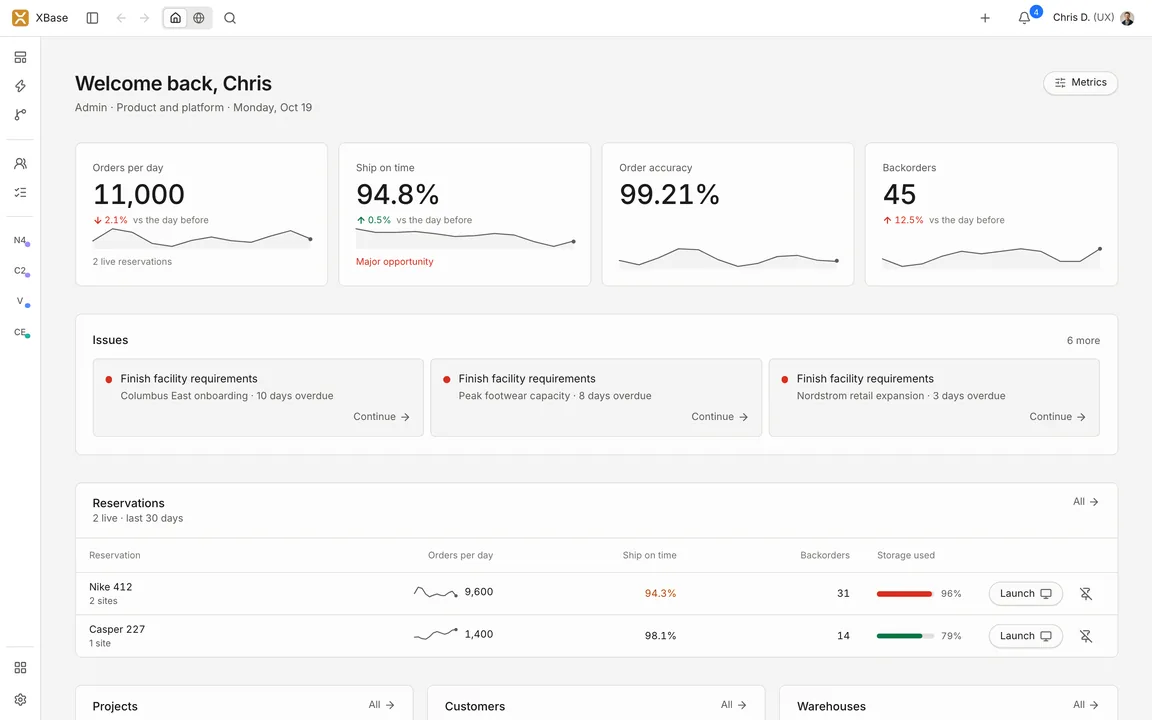
The XBase home screen
Company
Flexe
Years
2020–2022
Team
VP of Operations, Director of Network Development, and a 12-person platform council
Role
Product & Design Lead

At a glance.

If we met in an elevator, this is what I’d tell you.

Pen and paper → XBase

As Flexe’s head of design, with no PM, I led the vision, design, and rollout of XBase: one platform that took every business process out of people’s heads and handoff meetings and into software. It started as a configuration tool and became the front end for the whole company. Errors fell 99%, net margin went from -2.5% to +12%, and engineers got 1,200 hours a month back.

Configuration without engineers. A new customer, set up in 30 minutes.

A guided, TurboTax-style flow let operations teams answer plain questions while XBase built the configuration file.

The Floor storage step of XBase's facility requirements: one plain question, how much floor space is needed, with every category and its status down the side

Set it up once. Apply it everywhere.

Templates for every program and every enterprise customer turned each new site into a few clicks.

Choosing a config template for a new project: templates for each program, and ones saved from customers' own reservations, each with the sections it brings

No more handoffs. Every team works on a launch at the same time.

Account managers kicked off a launch mid-call and assigned each module to the right person across the company.

Casper 227's configuration, 16 of 22 modules done: each module owned by a team, like legal or inventory, with who has it and when it's due

Designed around how each team really worked.

Account managers got one dense page so calls felt like conversations, and every other team got short, focused steps so nothing was missed.

The account manager's pre-qual page for a new project: rows of one-tap answers, with a live complexity score beside them

It catches mistakes before they happen.

Dependent settings appear on their own, formatting is handled for you, and every configuration runs on mock data before go-live.

The Storage question with Floor and Racks checked, and Floor storage and Rack details now listed under Storage

Status is a screen, not a meeting.

Executives saw the whole pipeline and every account’s numbers, with big swings flagged automatically.

Nike's account: a flag that a packaging material is below its reorder point, the month's numbers, and every stat with its change marked up or down

Ten tools, one login.

Every internal tool behind one login, with each person seeing only their customers and their lane.

The person menu: switch modes, find a reservation, and launch any of your own reservations as the customer or the warehouse

Growing pains

Bigger customers. Bigger problems.

A brand like Casper sells two mattresses in three sizes. Enterprise retailers like Walmart, Nike, and Home Depot ship hundreds of thousands of products, thousands of units a day, out of tight spaces. Every new deal brought more steps, more requirements, and more people to keep track of it all. In about 18 months, we went from a 15% margin to losing money on every new account, leaving Flexe at a -2.5% net margin.

 3–5accounts per account manager

 15%+billing errors

 1,200engineering hours a month on configuration

15% →−2.5%net margin

The messy middle

An unsolved mystery.

To cut costs, our Director of Technical Solutions wanted every customer to follow the same path, passed from team to team, with requirements collected in one spreadsheet. She asked me to map our intake-to-launch process. The map showed how messy it really was, and that passing work team to team would be far too slow. The spreadsheet showed who owned each step, but it couldn’t connect the dependencies between teams, and that’s where the errors occurred.

The first pitch

What you see is what you get.

Even with the spreadsheet, engineers still had to hand-code every configuration. So I asked: why have engineers doing this at all? Why not empower our teams to do the configurations themselves? With the right tool, we could also track the dependencies automatically, and those were causing our errors. I ran through a sample demo of facility requirements. Our CEO’s reaction: in our wildest dreams, but far too complex and costly to build, with a roadmap already full.

Lesson learned · Lead with the business problem, not the tool.

Building a coalition

Creating and selling a vision of the future.

After my first pitch, I worked with our VP of Operations to form a coalition of leaders across business and operations, and kept building a more functional version of the prototype.

Round two

Defining what success looks like.

This time, I didn’t open with the prototype. I opened with what success would look like for every team.

⚑ Not written yet: what success looks like for each team

Team name

Success line

Team name

Success line

Team name

Success line

Team name

Success line

Team name

Success line

Team name

Success line

Proof of concept

A whole new customer, configured in 30 minutes.

Nike 412's configuration, all 24 modules complete, with everything they turn on in XShip and XOrder

The first official project: a simple Shopify customer at an existing site. Built from scratch in XBase, it was as fast as an engineer copying a matching customer’s files, with no engineer involved.

Under one roof

A single source of truth. The whole company. One app.

Ten tools. One login.

Configuration, reservations, accounts, billing, Marketplace, and more, all in one place.

Only what you need.

Role-based access meant each person saw only their own customers and lane, which got us SOC 2 compliant for enterprise customers.

Designed around how each team really worked.

A conversation, not a questionnaire.

The account manager's pre-qual rows on a new project's hub, with the chosen answers grayed in

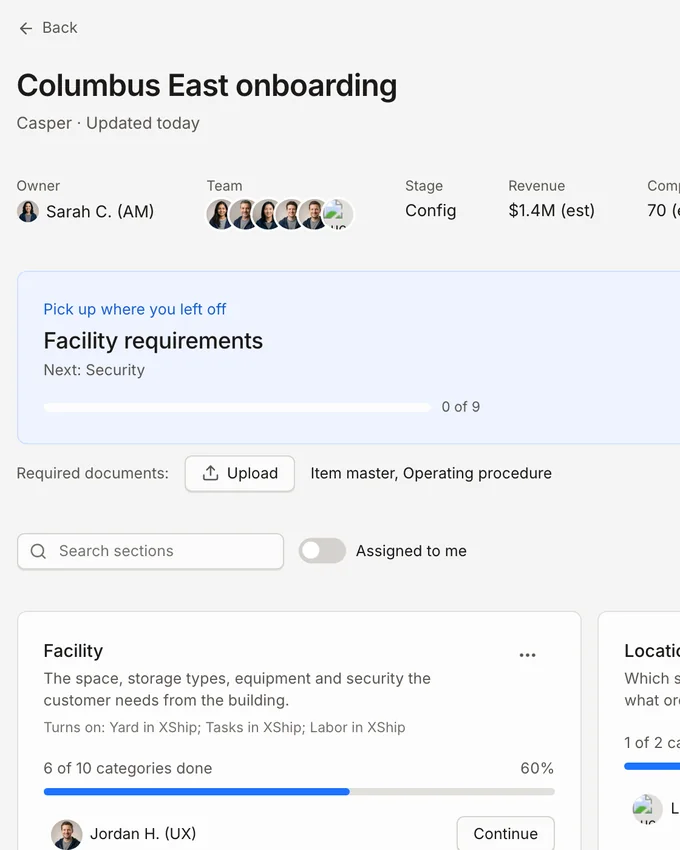
All teams, one place.

Project Hub for Columbus East onboarding: the owner, the team, the stage, where to pick up, and each section's progress

Done means done.

Module categories, each either complete or waiting on Mark complete, even once every question is answered

Your customers, one click away.

Diego Marchetti's profile, with the 11 customer accounts Diego manages

Access granted.

Inviting someone to XBase: their email, their team and their role

The business at a glance.

The All Flexe dashboard: revenue, net margin, go-lives and live reservations, and revenue by month

Every launch, in one view.

Projects: every launch with its stage and progress

No loose ends

Every dependency, linked.

The outcome

Back on track.

3–5 →10–15Accounts per account manager

 99%fewer billing and configuration errors

 1,200engineering hours a month, back to building product

−2.5% →+12%Net margin

Let's build incredible0→1 products together.

0→1 products =UrUser Research+UxUser Experience Design+PtPrototyping+TsTesting